Learn how to match a cup machine, custom mold, PP/PS/PET sheet extruder, auxiliaries, recycling, stacking and packing for a complete factory.
# How to Build a Complete Plastic Cup Production Line
**Meta title:** Plastic Cup Production Line: Machines, Mold and Process
**Meta description:** Learn how to match a cup machine, custom mold, PP/PS/PET sheet extruder, auxiliaries, recycling, stacking and packing for a complete factory.
**Primary keyword:** plastic cup production line
**Secondary keywords:** plastic cup making machine parameters, cup mold design, plastic sheet extrusion line, disposable cup manufacturing process, turnkey cup factory
Building a plastic cup factory is not a matter of buying one thermoforming machine. A workable production line must connect the finished cup design to the mold, cup machine, sheet specification, extrusion capacity, compressed air, cooling, scrap handling, stacking and packing. The safest selection method is to start with the cup sample and work backward through every process step.
This guide uses the WEIXIN standard WX-660, WX-720, WX-750 and WX-850 model families to explain the selection logic. Exact project parameters vary between cylinder, servo, high-speed and used configurations, so a final technical sheet is still required before quotation and production.
Define the Cup Before Selecting the Machine
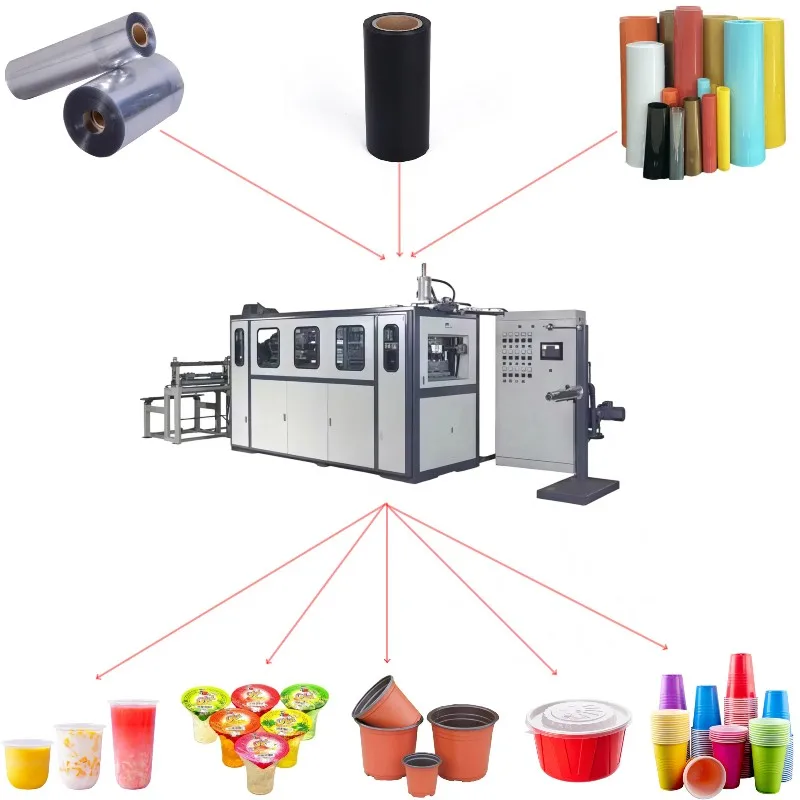
Start with the physical product: water cup, milk-tea cup, yogurt cup, jelly cup, dessert cup, portion cup, bowl or another deep round container. Record the rim diameter, bottom diameter, height, unit weight, material, color, stacking direction and expected hourly output. These values determine the required forming area, depth and mold layout.
The cup's shape also confirms whether a cup machine is the correct equipment. Deep round products are the primary application of a plastic cup making machine. Rectangular takeaway boxes, shallow trays, fruit boxes and many lids are generally better suited to a three-station thermoforming machine. Making this distinction before quotation prevents the buyer from purchasing a machine that cannot handle the intended product efficiently.
Material is equally important. PP, PS, PET and PLA have different heating and forming behaviors. The sheet thickness must be selected together with the product weight and geometry. A thin sheet may not distribute enough material into a deep cup, while an unnecessarily thick sheet can increase material consumption. Product and sheet development must therefore be handled as one engineering task.
Compare the WX-660, WX-720, WX-750 and WX-850
The model family defines the available working envelope, but the largest model is not automatically the best choice. A smaller machine with an efficient mold can be more suitable for one cup, while a larger forming area may support more cavities, a larger diameter or deeper products. Standard family data provides a starting point for technical matching.
| Model | Forming area | Max sheet width | Sheet thickness | Max depth | Cup diameter | Typical output | |---|---|---|---|---|---|---| | WX-660 | 660 × 320 mm | 680 mm | 0.3–2.0 mm | 150 mm | 40–95 mm | 20,000–45,000 pcs/h | | WX-720 | 720 × 420 mm | 760 mm | 0.3–2.5 mm | 160 mm | 55–98 mm | 25,000–55,000 pcs/h | | WX-750 | 750 × 500 mm | 780 mm | 0.3–3.0 mm | 170 mm | 60–110 mm | 30,000–65,000 pcs/h | | WX-850 | 850 × 560 mm | 880 mm | 0.3–3.0 mm | 180 mm | 65–120 mm | 35,000–80,000 pcs/h |
Reference speeds are 15–35 cycles/min for WX-660, WX-750 and WX-850 and 15–36 cycles/min for WX-720. Standard installed-power ranges are 45–60, 55–70, 60–75 and 70–85 kW respectively. All four model families use a reference compressed-air range of 0.6–0.8 MPa. Suggested chillers progress from 3–5 HP for WX-660 to 10 HP for WX-850.
These are selection references, not guaranteed order values. Output is governed by confirmed cavities, practical cycle speed and operating efficiency. Exact machine type and configuration must be identified before parameters are quoted.
Design the Cup Mold as Part of the Production System
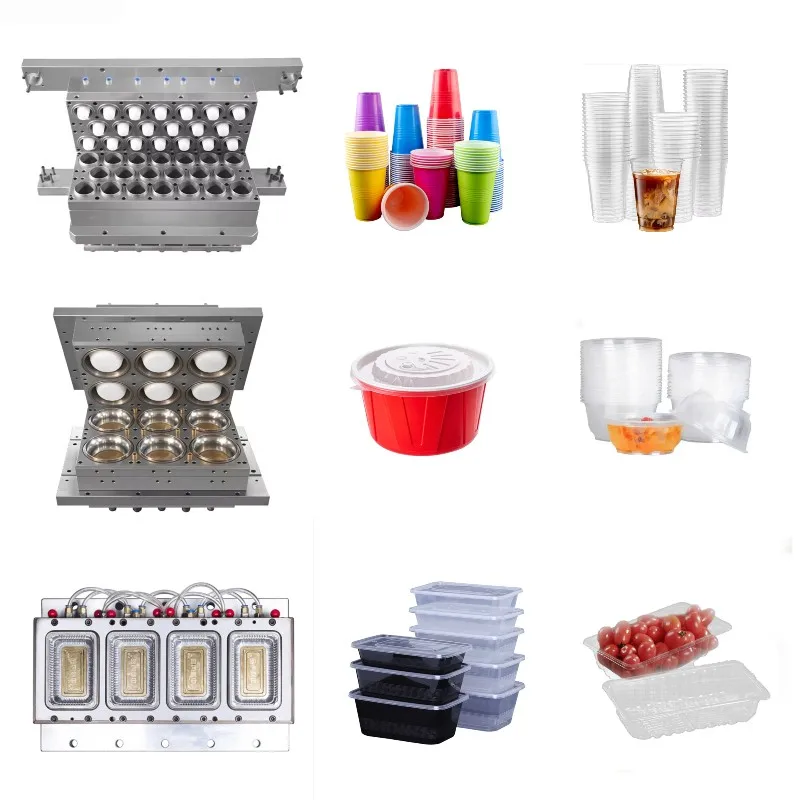
The mold defines how many cups are formed per cycle, but cavity count cannot be maximized without considering the process. Mold engineers must balance cavity layout, sheet utilization, heating uniformity, cooling, cutting clearance, release and stack handling. A mold that fills the working area but releases poorly can reduce production stability.
Key inputs include cup rim and bottom diameters, cup height or draw depth, draft angle, product weight, material, sheet thickness and nesting geometry. Rim diameter affects how cavities fit across the forming area. Cup height influences draw requirements. Draft and bottom geometry affect release and stacking. Product weight and sheet thickness determine how much material must be distributed into the walls and base.
Theoretical output can be estimated as cavities × cycles/min × 60. For example, standard references for a 7 oz cup include 24/28 cavities on WX-660, 28/32 on WX-720, 32/36 on WX-750 and 36/45 on WX-850. Those numbers should never be copied to a different cup without a layout review. Every product needs its own cavity, cooling and stacking assessment.
Understand the Full Manufacturing Process
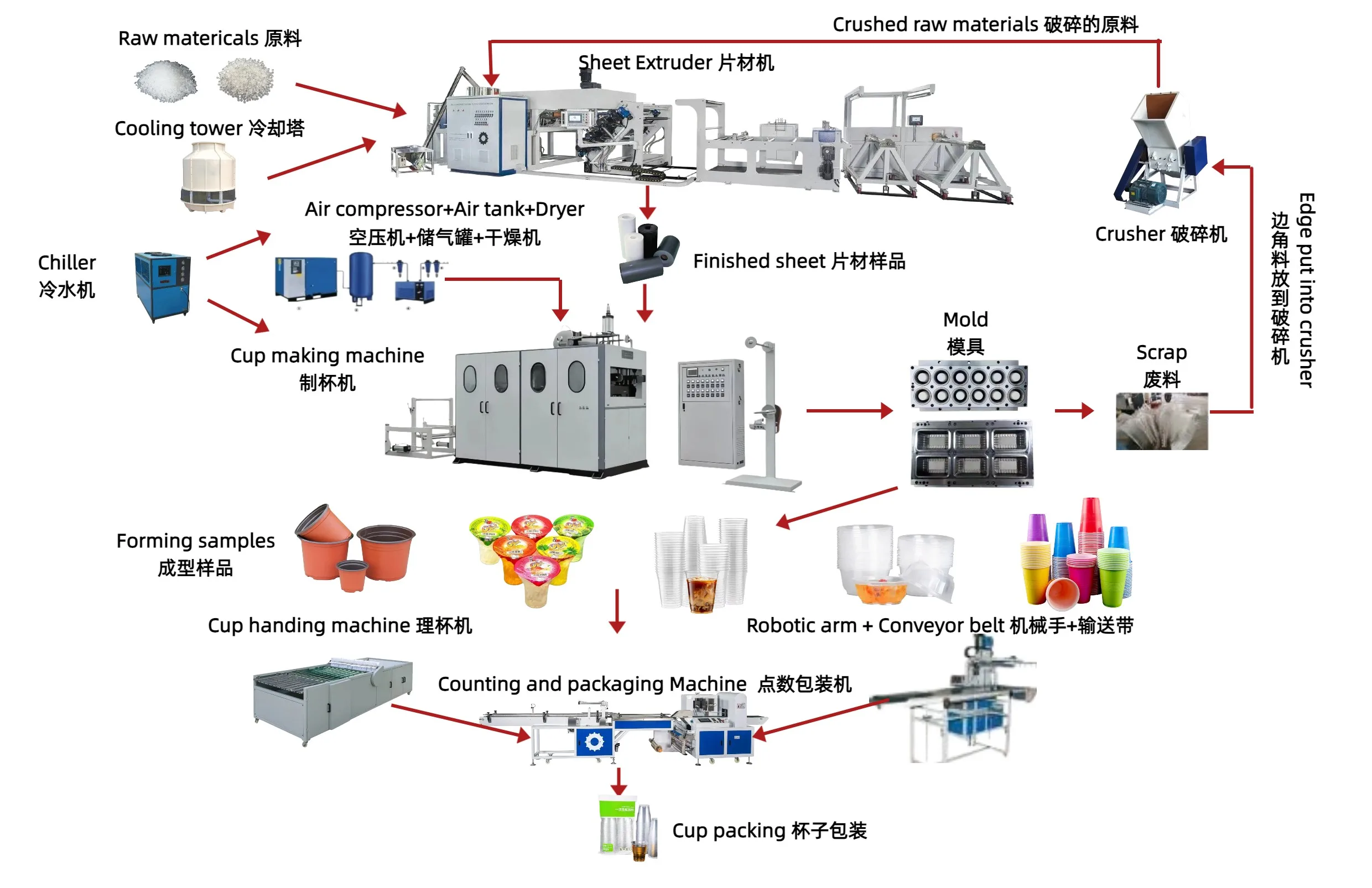
When the factory makes sheet in-house, production begins with plastic granules. The resin is fed into the sheet extrusion line, heated and plasticized, distributed through a flat die and formed into continuous sheet by a roll stack. The sheet is cooled and wound into rolls sized for the cup machine. Stable thickness, roll tension and weight consistency are essential for repeatable cup forming.
The cup machine unwinds and advances the sheet through its heating section. Once the material reaches the correct forming range, the mold forms and cuts or separates the cups. The products are released and collected by a belt stacker, robot or conveyor. A counting and packing system can then prepare the required number of cups for bags or sleeves.
The remaining sheet skeleton is fed to a crusher. Regrind handling depends on the resin recipe, product specification and food-contact requirements. If reuse is permitted, controlled ground material can return to the extrusion process. The complete route is therefore raw material → sheet extrusion → roll winding → sheet heating → forming and cutting → cup stacking → counting and packing, with a defined recycling loop.
Match the Sheet Extrusion Line to the Cup Machine
The extrusion line should be chosen only after the downstream cup and forming machine are defined. Confirm material, virgin/recycled blend, sheet width, thickness range, required kg/h, roll core, roll diameter and winding direction. Also confirm whether the sheet will be single-layer or multilayer and what cooling water, power and factory space are available.
PP and PS cup projects normally focus on stable thickness, cooling, winding and material consistency. Selected PET cup projects require careful confirmation of material preparation, filtration, degassing, transparency and thermoforming response. PLA and other materials require project-specific evaluation rather than a generic promise of compatibility.
The extrusion output should align with total sheet consumption. A line that is too small may restrict the cup machines, while a line that is too large may create unnecessary changeovers or inventory. If the factory operates several cup machines or several materials, total daily demand, roll widths and changeover strategy should be calculated before selecting one large line or multiple lines.
A startup factory does not always need an extruder immediately. Purchased sheet can reduce the first-stage equipment scope when local supply is reliable. In-house extrusion is more attractive when sheet quality, supply security and long-term production economics justify the added equipment and process responsibility.
Add the Required Utilities and Automation
The cup machine needs compressed air and cooling. A complete air system commonly includes an air compressor, air tank and dryer, sized to the selected machine and production load. Cooling can include a chiller and cooling tower depending on the machine, mold and factory conditions. Utility capacity must be checked for simultaneous operation rather than one machine at a time.
Material and scrap systems may include a mixer, automatic loader and crusher. The loader moves resin to the extruder, while the crusher handles the thermoforming skeleton. Recycling design must keep material streams controlled and must comply with product requirements. Conveyors and storage areas should prevent contamination and excessive manual handling.
Downstream automation is selected from the cup. A belt cup stacker may suit products that nest reliably. Robots and conveyors can provide different handling paths. Counting and packing machines are added when the required pack format, cup stack and production rate are confirmed. Automation should solve a defined handling task; it should not be added simply to make an equipment list appear more complete.
Factory planning must also cover mold-change space, maintenance access, raw-material storage, roll-sheet staging, finished-product storage, ventilation and safe operator routes.
Products and Samples the Complete Line Can Make
The WX cup-machine family is designed primarily for cups, bowls and deep round thermoformed products. Examples include disposable water cups, juice and cold-drink cups, milk-tea cups, yogurt cups, jelly cups, dessert cups, sauce or portion cups, flower pots and selected round food containers. The applicable material and machine model depend on the product.
Transparent PET or PS sheet can be considered for clear cups where the project configuration supports it. PP is widely used for cups and bowls requiring suitable toughness and heat resistance. Colored sheet can produce branded or category-specific products. The mold surface, cup geometry and sheet formulation all influence the final appearance.
The sample images are useful for illustrating possibilities, but they are not a substitute for technical matching. A wide-mouth bowl, a tall drink cup and a small jelly cup use different mold layouts and may require different forming depth, stacking and output assumptions. Buyers should identify the priority product for the first mold and treat later cup sizes as separate tooling projects.

Verify the Line With Material and Mold Testing
A useful factory test should demonstrate the agreed product rather than only the machine moving without material. For the cup machine, document the sheet material, thickness and width; mold cavity count; cup dimensions and weight; cycle setting; release and stacking result; and finished-product appearance. Retain samples for buyer review.
When the order includes a sheet extrusion line, also inspect the process from granules to wound sheet. Record the material recipe, usable sheet width, thickness measurements and winding result. If possible, feed the produced roll into the cup machine. This confirms the most important interface in the complete line: whether the upstream sheet runs correctly in the downstream forming process.
<video controls preload="metadata" width="100%" poster="https://sc02.alicdn.com/kf/Hfc434dbda6f9469ab0339c98bce78b34Q.jpg"> <source src="https://sc02.alicdn.com/kf/Hde3fa286d6cc424c9129a7e0f74e5d66e.mp4" type="video/mp4"> Your browser does not support the video tag. </video>
Video records should not be described as proof of a specific speed or acceptance result unless the footage and test data support that claim. Written test conditions and measured samples make the evidence more useful for both buyer and supplier.
Frequently Asked Questions
What machines are required for a plastic cup factory?
A complete line can include a sheet extrusion line, cup making machine, custom mold, air compressor, air tank, dryer, chiller, cooling tower, mixer, loader, crusher, cup stacker, conveyor and counting/packing equipment. The exact scope depends on sheet supply and automation level.
Can the same machine make different cups?
Yes, within the machine's forming area, depth and material capabilities, but each cup usually requires a dedicated mold. Changeover, stacking and sheet requirements must also be considered.
Should I choose the largest WX model?
Not automatically. Choose the model that fits the cup dimensions, mold layout, output target and available sheet. Oversizing can add cost without improving the project.
Can I start without a sheet extrusion line?
Yes. If suitable sheet is available locally, purchasing rolls can reduce initial investment. Add extrusion when daily consumption, supply stability and quality-control needs support it.
How many mold cavities do I need?
Cavity count is calculated from cup geometry, working area, target output and practical cycle. More cavities are not always better because cooling, cutting, release and stacking must remain stable.
What information is required for a quotation?
Provide a cup sample or drawing, rim diameter, bottom diameter, height, weight, material, sheet thickness, target output, voltage, workshop size and whether you need sheet extrusion and automatic packing.
Plan the Factory From the Product Backward
The correct order is product → material and sheet → mold → cup machine → utilities → cup handling and packing. Starting with a machine model and trying to force every future product onto it increases project risk. Send WEIXIN Machinery the finished cup details first, and the equipment list can be built around the actual manufacturing objective.
For a new factory, define one priority cup and one realistic production target. Confirm whether sheet will be purchased or extruded in-house, then calculate mold cavities, machine cycles, sheet demand, compressed air, cooling and packing labor as one system. This sequence creates a clearer technical and commercial comparison than collecting unrelated machine quotations.
Expansion should also be planned. Reserve workshop space and utility capacity for later molds, another cup machine or a sheet line where justified, but avoid buying equipment that has no defined role in the initial product route. A phased factory can reduce startup complexity while keeping a practical path to higher automation and output.
For a conversion-focused overview of the equipment scope, WX machine families and turnkey configuration, see the [complete plastic cup production line product page](https://thermoformmachinery.com/complete-plastic-cup-production-line.html).
**Knowledge-base references:** *WEIXIN-PS-01 Plastic Cup Making Machine Product Parameter Specification*, *WEIXIN-PS-05 Thermoforming Mold/Cup Mold Product Parameter Specification*, *WEIXIN-KB-05 Plastic Sheet Extrusion Line Deep Product Knowledge*, and *Cup Making Machine FAQ*.